
Blog
K2 Street Names: The Essential Slang Glossary (2026)

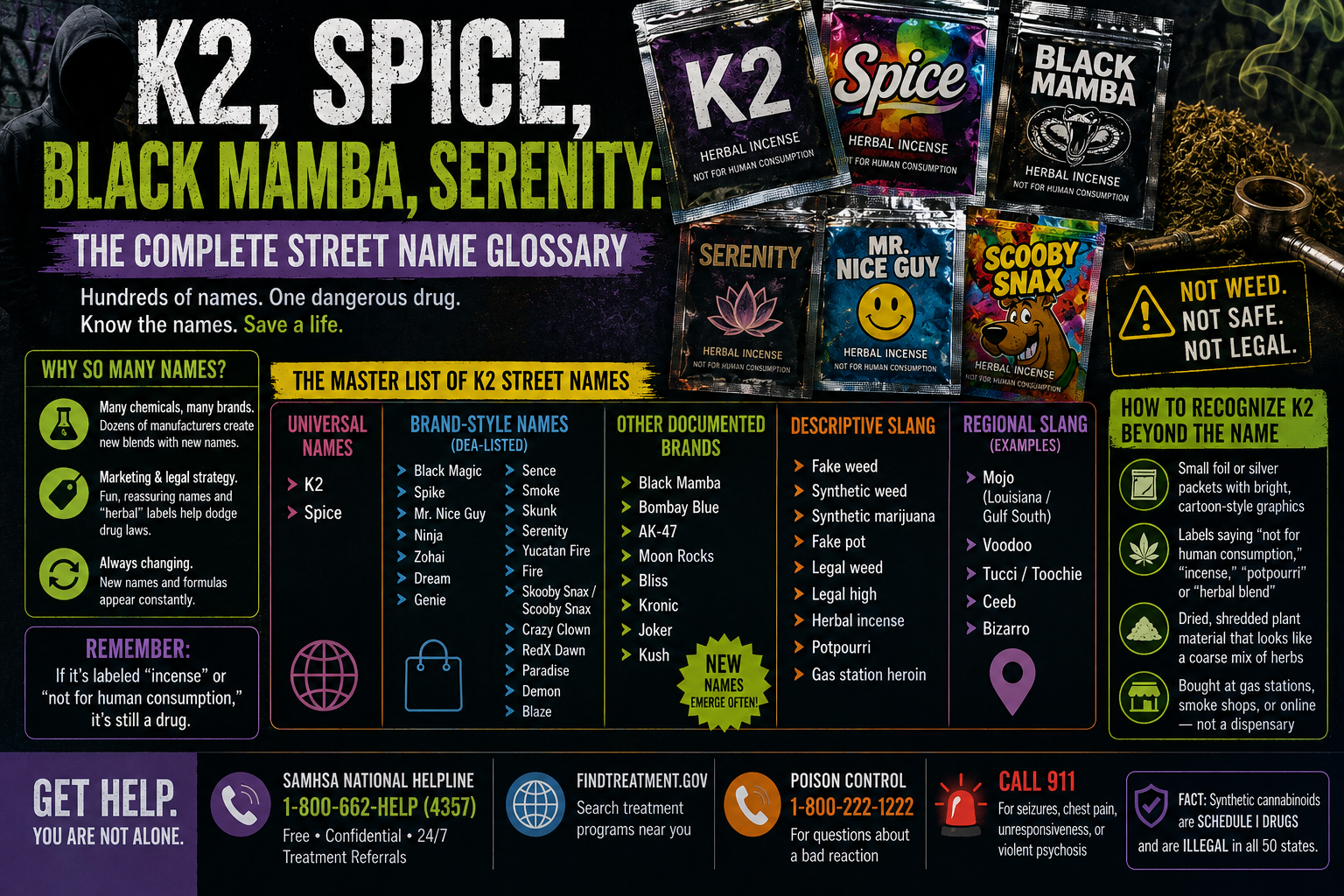
K2, Spice, Black Mamba, Serenity: The Complete Street Name Glossary
Learning the K2 street names in circulation is one of the most practical things a parent, teacher, or healthcare worker can do — because this is a drug that hides behind its vocabulary. There are hundreds of brand names and slang terms for synthetic cannabinoids, and new ones appear constantly. A packet labeled “Serenity” or “Mr. Nice Guy” can look harmless right up until it sends someone to the emergency room.
This glossary pulls together the most common K2 street names and slang, explains where the terms come from, and clears up the specific ones people search for most — like “gas station heroin,” “spike,” and “ceeb.” Everything here is drawn from the DEA, NIDA, and other public-health sources.
Table of Contents
- Why K2 Has So Many Street Names
- The Master List of K2 Street Names
- Brand-Style Names (Spice, K2, Black Mamba)
- Descriptive Slang (Fake Weed, Legal High)
- Confusing Terms People Search For
- How to Recognize K2 Beyond the Name
- Getting Help
- Frequently Asked Questions
Why K2 Has So Many Street Names
Most drugs pick up a handful of nicknames. Synthetic cannabinoids have hundreds. There are two reasons for that.
First, K2 isn’t one substance — it’s a whole class of lab-made chemicals, and dozens of manufacturers each brand their own product. Every new blend gets a new name.
Second, the names are a marketing and legal strategy. Bright, playful branding like “Scooby Snax” or reassuring words like “Serenity” make an unregulated chemical sound fun or safe. Labels like “herbal incense” and “potpourri” help sellers dodge the law.
The result is a moving target. That’s exactly why knowing the K2 street names matters: the vocabulary is often the first clue that something is wrong.
The Master List of K2 Street Names
The two most universal names are simply K2 and Spice. Beyond those, the DEA’s K2/Spice fact sheet and Drugs.com document dozens of brand and slang names. Here are the most commonly cited synthetic cannabinoids names:
| Category | Common Names |
|---|---|
| Universal names | K2, Spice |
| DEA-listed brand names | Black Magic, Spike, Mr. Nice Guy, Ninja, Zohai, Dream, Genie, Sence, Smoke, Skunk, Serenity, Yucatan Fire, Fire, Skooby Snax / Scooby Snax, Crazy Clown, RedX Dawn, Paradise, Demon, Blaze |
| Other documented brands | Black Mamba, Bombay Blue, AK-47, Moon Rocks, Bliss, Kronic, Joker, Kush |
| Descriptive slang | Fake weed, synthetic weed, synthetic marijuana, fake pot, legal weed, legal high, herbal incense, potpourri, gas station heroin |
| Regional slang | Mojo (Louisiana / Gulf South), Voodoo, Tucci / Toochie, Ceeb, Bizarro |
This is not exhaustive — the DEA has identified dozens of controlled compounds and dozens more uncontrolled ones circulating under ever-changing names. But if a small foil packet carries one of these labels, treat it as a serious warning sign.
Brand-Style Names: Spice, K2, Black Mamba, and More
These read like product names because they were designed to. A few worth knowing specifically:
Spice was one of the earliest brands to hit Europe in the mid-2000s, and the name became a generic term for the whole drug class, much like “K2” did in the U.S. If you’re wondering what “Spice” is slang for, the answer is simply synthetic cannabinoids — there’s no cannabis in it at all.
K2 is the other generic catch-all, more common in the U.S. Both terms now function as umbrella labels.
Black Mamba and Black Magic lean on menacing, potent-sounding imagery.
Serenity, Mr. Nice Guy, and Dream do the opposite — they use calming, friendly branding to make a dangerous product feel gentle. The “Mr. Nice Guy” brand in particular is a frequently searched K2 street name for exactly this reason.
Scooby Snax (also spelled Skooby Snax) and Crazy Clown use cartoon-style branding that public-health officials have repeatedly flagged as designed to appeal to teenagers.
Descriptive Slang: Fake Weed, Legal High, and Herbal Incense
Alongside brand names, a second layer of K2 slang describes what the drug pretends to be. The most common fake weed names include fake weed, synthetic weed, fake pot, and synthetic marijuana — all misleading, because K2 contains no marijuana and is pharmacologically very different from it. (We break this down fully in our guide to K2 vs weed.)
Then there’s the marketing vocabulary: legal high, legal weed, herbal incense, and potpourri. These terms, combined with “not for human consumption” labeling, are deliberate attempts to sidestep drug laws. They do not mean the product is legal — synthetic cannabinoids are Schedule I substances, as explained in our post on synthetic marijuana laws.
Confusing Terms People Search For
A few specific slang terms generate a lot of confusion, so let’s clear them up directly.
“Gas station heroin.” This alarming phrase is used loosely in the media and online. It has been applied to several unregulated substances sold at convenience stores — sometimes synthetic cannabinoids like K2, and sometimes other drugs such as tianeptine. The takeaway is the theme, not a single chemical: cheap, unregulated, gas-station intoxicants of unpredictable and dangerous composition.
“Spike.” Spike is one of the DEA-documented brand names for a synthetic cannabinoid product. As with the others, it’s plant material sprayed with lab-made chemicals.
“Ceeb.” Ceeb (sometimes “seeb”) is street slang used in some regions for synthetic cannabinoids. Like most K2 slang, it’s regional and shifts over time.
“K2 on Urban Dictionary.” People often check Urban Dictionary for these terms. That’s understandable, but crowd-sourced slang sites aren’t reliable for health information — the definitions are inconsistent and unvetted. For accurate information, stick with sources like the National Institute on Drug Abuse (NIDA).
How to Recognize K2 Beyond the Name
Because the names change so often, it helps to recognize the product itself. Common signs include:
- Small foil or silvery plastic packets, often with bright, cartoon-style graphics
- Labels reading “not for human consumption,” “incense,” “potpourri,” or “herbal blend”
- Dried, shredded plant material that looks like a coarse mix of herbs
- A product bought at a gas station, smoke shop, or online rather than a dispensary
For a fuller identification guide, see our post on the symptoms and warning signs of K2 use.
Getting Help
If you recognize these names because someone you care about is using K2, help is confidential and available.
- SAMHSA National Helpline: 1-800-662-HELP (4357) — free, confidential, 24/7 treatment referrals
- findtreatment.gov — search treatment programs near you
- Poison Control: 1-800-222-1222 — for questions about a bad reaction
- 911 — for seizures, chest pain, unresponsiveness, or violent psychosis
Frequently Asked Questions
What are the most common K2 street names?
The most common K2 street names are K2 and Spice, followed by brand names like Black Mamba, Serenity, Mr. Nice Guy, Scooby Snax, Spike, and Black Magic, plus descriptive slang such as fake weed, legal high, and herbal incense.
What is “Spice” slang for?
Spice is slang for synthetic cannabinoids — lab-made chemicals sprayed onto plant material to mimic THC. Despite the “synthetic marijuana” nickname, Spice contains no cannabis.
Is “gas station heroin” the same as K2?
Not always. “Gas station heroin” is a loose media term for cheap, unregulated intoxicants sold at convenience stores. It has referred to synthetic cannabinoids like K2 as well as other substances such as tianeptine.
Why does K2 have so many names?
Because it’s a whole class of chemicals made by many manufacturers, each branding its own product, and because playful or reassuring names help sellers market an unregulated drug and evade the law. New names appear constantly.
Where can I find reliable information on synthetic cannabinoid names?
Trusted sources include the DEA’s K2/Spice fact sheet and NIDA. Crowd-sourced slang sites like Urban Dictionary are not reliable for health or safety information.