
Blog
K2 vs Weed: Why This Dangerous “Synthetic” Isn’t Cannabis

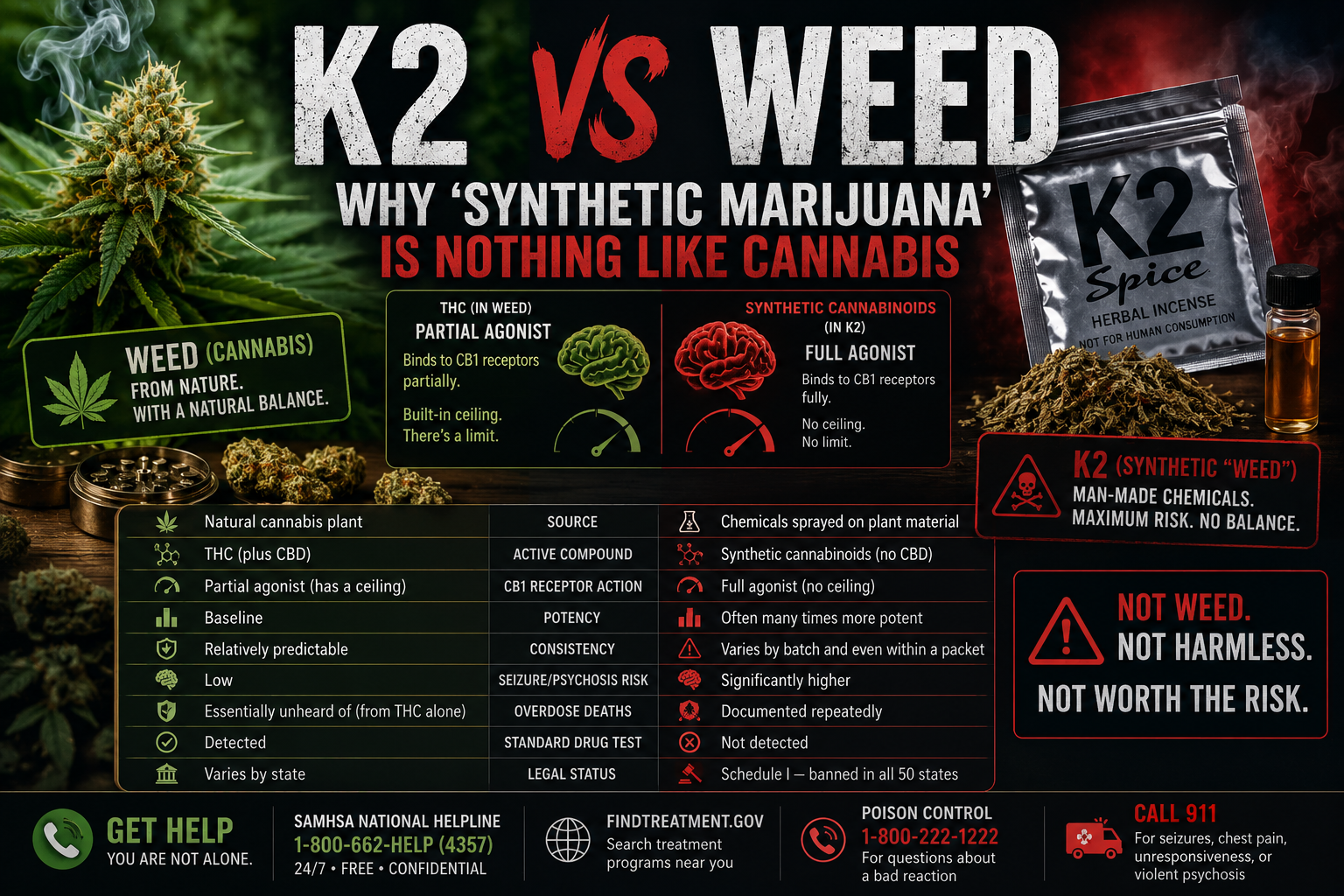
K2 vs Weed: Why ‘Synthetic Marijuana’ Is Nothing Like Cannabis
When people search K2 vs weed, they’re usually trying to settle one question: is synthetic “marijuana” basically just a stronger, cheaper version of cannabis? The answer is a clear and important no. Despite the marketing, K2 and weed are not two versions of the same thing — they’re fundamentally different drugs, and mistaking one for the other has landed thousands of people in the emergency room.
This guide breaks down the K2 vs weed comparison honestly: what each one actually is, the single pharmacological difference that explains everything, how their effects and risks diverge, and why the name “synthetic marijuana” is so dangerously misleading.
What Is Weed?
Weed — marijuana, cannabis — is the dried flower of the Cannabis sativa plant. Its main psychoactive ingredient is THC (delta-9-tetrahydrocannabinol), a naturally occurring compound.
Crucially, cannabis also contains CBD (cannabidiol) and dozens of other compounds. CBD has calming, anti-anxiety, and anticonvulsant properties that appear to buffer some of THC’s effects.
This natural balance matters. It’s a big part of why the K2 vs weed comparison falls apart the moment you look under the hood.
What Is K2?
K2 — also called Spice, fake weed, or synthetic weed — is not a plant. It’s dried, shredded plant material sprayed with lab-made chemicals known as synthetic cannabinoids.
These chemicals, with names like JWH-018 and MDMB-Fubinaca, were designed to activate the same brain receptors as THC. There are hundreds of them, and manufacturers change formulas constantly to dodge drug laws and tests.
Two facts define K2. First, it contains no cannabis and no CBD whatsoever. Second, its exact chemical makeup is unknown to the person using it — and can change from one packet to the next. If you want the full picture of what it does to the body, see our guide to K2 side effects.
K2 vs Weed: The Core Pharmacological Difference
Here’s the single most important thing in the entire K2 vs weed debate, and it comes down to how each drug binds to the brain’s CB1 cannabinoid receptors.
THC is a partial agonist. It binds to CB1 receptors but only partially activates them. This gives cannabis a built-in ceiling — there’s a natural limit to how hard THC can push the system.
Most synthetic cannabinoids are full agonists. According to peer-reviewed toxicology research, the compounds in K2 act as full agonists at CB1 and CB2 receptors, activating them with maximum force and no ceiling.
On top of that, they bind more tightly than THC. Research summarized by NIDA and clinical literature notes binding affinities many times greater than THC — with some studies estimating certain synthetic cannabinoids to be dramatically more potent than cannabis.
There’s one more difference that ties it together: K2 has no CBD to soften the ride. You get a full-throttle, uncapped activation with none of cannabis’s natural counterbalance.
Synthetic Weed vs Real Weed: How the Effects Diverge
That pharmacological gap explains why the synthetic weed vs real weed experience splits so sharply once things go wrong.
Weed’s typical effects include euphoria, relaxation, altered perception, hunger, and — at higher doses — anxiety or paranoia. Overdose deaths from THC alone are essentially unheard of.
K2’s effects can start out similar but frequently escalate into territory cannabis rarely reaches: severe agitation, hallucinations, psychosis, seizures, and violent behavior.
A systematic review of K2/Spice toxicity found that synthetic cannabinoids carry higher toxicity and longer-lasting effects than THC, with a notably higher risk of triggering seizures and psychosis — especially dangerous for people with epilepsy or schizophrenia.
Put simply: with weed, a “too much” experience is usually uncomfortable. With K2, a “too much” experience can be a medical emergency.
Why K2 Is So Much More Dangerous
1. Uncapped potency. Full-agonist activity means no ceiling on the effects — the exact opposite of THC’s self-limiting nature.
2. No quality control. Because the chemicals are sprayed on unevenly, one pinch can be many times stronger than the next. Even the same packet isn’t consistent.
3. Constantly changing chemistry. Each new formula is essentially an untested drug. Nobody — including the user — knows the true potency or risk.
4. Contamination. Unregulated products have been laced with other poisons; in 2018, K2 cut with rat poison caused a deadly outbreak of severe bleeding tracked by the CDC.
5. Undetectable on standard tests. Many people switch to fake weed believing it’s “safer” because it evades drug screens — a dangerous trade-off explained in our K2 drug test guide.
Cannabis carries its own real risks and isn’t harmless. But on the specific question of acute danger, the K2 vs weed comparison isn’t close.
The “Fake Weed” Marketing Myth
The name is the problem. Calling K2 “synthetic marijuana” or “fake weed” implies it’s a lab-made copy of cannabis — a familiar substance with familiar risks.
It isn’t. Toxicologists are blunt about this: these are entirely different chemicals sprayed onto plant material, and the “synthetic marijuana” label is misleading.
The comparison people should make isn’t “weed vs a stronger weed.” It’s “a plant with a natural ceiling” vs “an unregulated, uncapped research chemical of unknown potency.” Once you frame the K2 vs weed question that way, the word “marijuana” stops making sense at all.
This matters because the myth drives behavior. People who’d never touch an unknown research chemical will try “fake weed” precisely because the name makes it sound tame. The marketing — “herbal incense,” “legal weed,” “not for human consumption” — is designed to reinforce that false comfort. (K2 is not actually legal; see our guide to synthetic marijuana laws.)
K2 vs Weed at a Glance
| Feature | Weed (Cannabis) | K2 (Synthetic “Weed”) |
|---|---|---|
| Source | Natural Cannabis plant | Chemicals sprayed on plant material |
| Active compound | THC (plus CBD) | Synthetic cannabinoids (no CBD) |
| CB1 receptor action | Partial agonist (has a ceiling) | Full agonist (no ceiling) |
| Potency | Baseline | Often many times more potent |
| Consistency | Relatively predictable | Varies by batch and even within a packet |
| Seizure/psychosis risk | Low | Significantly higher |
| Overdose deaths | Essentially unheard of from THC alone | Documented repeatedly |
| Standard drug test | Detected | Not detected |
| Legal status | Varies by state | Schedule I; banned in all 50 states |
Getting Help
If you or someone you know is using K2, Spice, or fake weed, help is confidential and available.
- SAMHSA National Helpline: 1-800-662-HELP (4357) — free, confidential, 24/7 treatment referrals
- findtreatment.gov — search treatment programs near you
- Poison Control: 1-800-222-1222 — for questions about a bad reaction
- 911 — for seizures, chest pain, unresponsiveness, or violent psychosis
If quitting is the goal, our guide to K2/Spice withdrawal explains what to expect and why medically supervised detox is safest.
Frequently Asked Questions
Is K2 the same as weed?
No. Weed is the natural cannabis plant, with THC as a partial receptor agonist and CBD to balance it. K2 is plant material sprayed with lab-made synthetic cannabinoids that are full agonists, far more potent, and contain no CBD. In the K2 vs weed comparison, they’re pharmacologically different drugs.
Is K2 stronger than weed?
Yes, often dramatically. Because synthetic cannabinoids fully activate CB1 receptors and bind more tightly than THC, many are estimated to be several times to many times more potent than cannabis — with no natural ceiling on their effects.
Why is synthetic weed vs real weed such a dangerous comparison?
Because the name “synthetic weed” implies similar risks, when in reality K2 causes seizures, psychosis, kidney failure, and death at rates cannabis does not approach. The familiar label creates a false sense of safety.
Does fake weed show up on a drug test like real weed?
No. Standard drug tests detect THC but miss synthetic cannabinoids. Detecting K2 requires a specialized panel that must be ordered specifically.
Is K2 legal since it’s marketed as fake weed?
No. Synthetic cannabinoids are Schedule I controlled substances under federal law and are banned in all 50 states, regardless of “legal” or “not for human consumption” labeling.