
Blog
What Are the Laws for Synthetic Marijuana? K2/Spice Legality

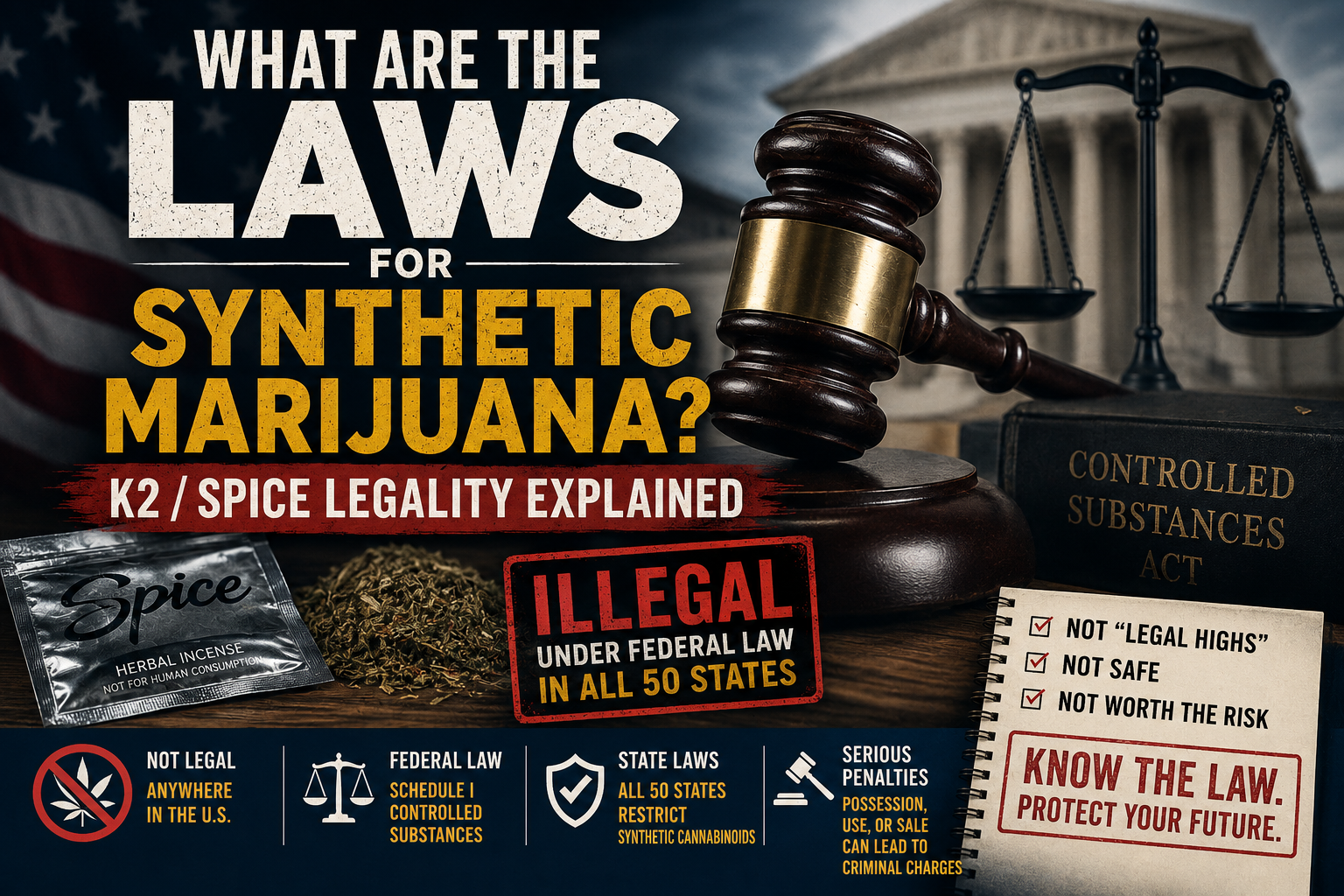
What Are the Laws for Synthetic Marijuana? K2/Spice Legality Explained
If you want to know what the laws for synthetic marijuana actually are, here’s the short version: K2 and Spice are illegal under U.S. federal law and banned in some form in all 50 states. The fact that these products have been sold in gas stations, smoke shops, and online — often labeled “legal” — does not make them legal. That “legal high” reputation is one of the most persistent and dangerous myths surrounding this drug.
This guide breaks down the federal law, why manufacturers keep trying (and mostly failing) to stay one step ahead of it, how state laws work, and what the specific rules look like in California, where two of the most common questions — is Spice legal in California? and is Spice illegal in California? — come up constantly.
Is K2 Legal? The Short Answer
No, K2 is not legal. Neither is Spice, nor any product sold under similar names like Black Mamba, Mojo, or Scooby Snax. Synthetic cannabinoids — the chemicals that make these products psychoactive — are controlled substances under federal law, and every state has enacted its own restrictions on top of that.
The confusion is understandable. For a few years around 2010–2012, these products genuinely did occupy a legal gray zone, sold openly as “herbal incense” or “potpourri.” But the law has since caught up. Today, treating K2 as legal because a store is willing to sell it is a serious mistake — one that can lead to criminal charges and, far more importantly, to a hospital visit.
Federal Law: Synthetic Cannabinoids Are Schedule I
The cornerstone of synthetic marijuana law in the U.S. is the Synthetic Drug Abuse Prevention Act of 2012, signed by President Obama as part of the FDA Safety and Innovation Act. This law permanently placed 26 types of synthetic cannabinoids and cathinones into Schedule I of the Controlled Substances Act.
Schedule I is the most restrictive category the federal government has. It’s reserved for substances considered to have a high potential for abuse, no accepted medical use, and no accepted safe level of use under medical supervision — the same tier as heroin and LSD. In other words, the federal government treats the chemicals in K2 as among the most dangerous controlled substances there are.
The 2012 law didn’t come out of nowhere. The DEA had already used its emergency scheduling authority in 2011 to temporarily control several synthetic cannabinoids, and the 2012 act made those controls permanent while doubling the maximum period the DEA can administratively schedule substances under its emergency authority, from 18 to 36 months.
The Analogue Act: Closing the “New Formula” Loophole
Here’s the central challenge in regulating synthetic cannabinoids: manufacturers respond to each ban by slightly tweaking the chemical structure, creating a new compound that technically isn’t on the banned list. It’s a constant game of catch-up.
Federal law has a tool for this. The Controlled Substance Analogue Enforcement Act of 1986 allows many synthetic drugs to be treated as controlled substances if they are proven to be chemically and/or pharmacologically similar to a Schedule I or Schedule II controlled substance. In plain terms: if a chemist invents a brand-new compound specifically designed to mimic a banned synthetic cannabinoid, prosecutors can charge it as if it were already illegal, even before it’s formally scheduled.
The Analogue Act isn’t a perfect fix — proving chemical similarity in court takes work, and the “not for human consumption” labeling on packaging is a deliberate attempt to create a legal defense. But it means the “it’s a new formula, so it’s legal” argument is far weaker than sellers and users often assume.
State Laws: All 50 States Restrict Synthetic Marijuana
On top of federal law, states have passed their own bans. Synthetic cannabinoids are restricted in some form in all 50 states, though the specifics — which compounds are listed, whether simple possession is criminalized, and the penalties — vary from state to state.
This dual system means a person can potentially face charges at either the state or federal level. In practice, most simple possession cases are handled by states, while federal agencies typically step in on larger manufacturing or trafficking cases.
Because state laws differ and are updated frequently as new compounds appear, the only reliable way to know the current rule where you live is to check your state’s controlled-substances statute or consult a local attorney. What’s consistent everywhere is that synthetic marijuana is not a legal product.
Is Spice Legal in California? Is Spice Illegal in California?
California is worth addressing specifically, because it’s a common point of confusion: recreational cannabis is legal there for adults, so people assume synthetic cannabis must be too. It isn’t. K2 and Spice are regulated far more strictly than marijuana in California.
The relevant statute is California Health and Safety Code § 11357.5, which makes it a crime to sell, dispense, distribute, furnish, or possess for sale any synthetic cannabinoid compound or derivative — and also to use or possess it. The penalties are structured roughly like this:
- Selling or distributing synthetic cannabinoids is a misdemeanor, punishable by up to six months in county jail and/or a fine of up to $1,000.
- Use or possession is a public offense: a first offense is an infraction with a fine of up to $250, with escalating penalties for repeat offenses that can rise to a misdemeanor.
California also took a deliberately broad approach: rather than listing only individual chemicals, the state defines whole classes of synthetic cannabinoids by structure and intended effect, and its rules extend to analogs — substances designed to have the same effect or a similar chemical structure. That makes it harder for a new formula to slip through. As California defense attorneys emphasize, assuming legality based on availability in a store is one of the most common and costly mistakes people make.
So to answer both questions directly: Spice is illegal in California to sell, use, or possess. The one nuance is that because the statute references specific compounds and their analogs, a defense sometimes hinges on whether a seized substance actually matches a covered compound — but that’s a courtroom technicality, not a green light.
Why the “Legal High” Myth Persists — and Why It’s Dangerous
If synthetic marijuana is illegal everywhere, why do so many people still think it’s legal? A few reasons:
- It’s often still sold openly. Enforcement isn’t always immediate, so products can remain on shelves after they’ve been banned. Availability creates a false impression of legality.
- The packaging is designed to mislead. Labels like “herbal incense,” “potpourri,” “not for human consumption,” and “legal” are marketing tactics meant to skirt regulations, not honest descriptions.
- The formulas keep changing. Each new compound creates a brief window of ambiguity before the law and testing catch up, which sellers exploit.
The real danger of this myth isn’t legal — it’s medical. People choose K2 believing “legal” means “safe,” when in reality synthetic cannabinoids are frequently far more potent and unpredictable than cannabis, and are linked to seizures, psychosis, kidney failure, and death. The legal status and the safety status point in the same direction: away from this drug. For more on the health risks, see our guide to K2 side effects.
Getting Help
If you or someone you know is using synthetic marijuana, help is confidential and available.
- SAMHSA National Helpline: 1-800-662-HELP (4357) — free, confidential, 24/7 treatment referrals
- findtreatment.gov — search for treatment programs near you
- Poison Control: 1-800-222-1222 — for questions about a bad reaction
For legal questions about a specific charge, a licensed criminal defense attorney in your state is the right resource — this article is educational and not a substitute for legal advice.
Frequently Asked Questions
Is K2 legal in the United States? No. The chemicals in K2 are Schedule I controlled substances under the federal Synthetic Drug Abuse Prevention Act of 2012, and all 50 states restrict synthetic cannabinoids. K2 is not a legal product anywhere in the U.S.
Is Spice illegal even if a store sells it? Yes. Being sold in a gas station or smoke shop does not make Spice legal. Enforcement isn’t always immediate, so banned products sometimes remain on shelves, but selling, possessing, or using them is still against the law.
Is Spice legal in California? No. Under California Health and Safety Code § 11357.5, it is illegal to sell, use, or possess synthetic cannabinoids in California — even though recreational cannabis is legal there. Synthetic marijuana is regulated much more strictly than marijuana.
Can a “new formula” of K2 be legal? Usually not. The federal Controlled Substance Analogue Enforcement Act lets prosecutors treat new compounds as controlled substances if they’re chemically or pharmacologically similar to banned ones, and states like California ban entire classes of compounds plus their analogs.
What are the penalties for synthetic marijuana? Penalties vary by state and by whether the charge is possession, use, or sale. In California, selling is a misdemeanor (up to six months in jail and a $1,000 fine), while possession starts as an infraction. Federal possession charges can carry up to a year in prison.