
Blog
K2 Drug Test: Does K2/Spice Show Up on a Screen?

K2 Drug Test FAQ: Does K2/Spice Show Up on a Standard Drug Screen?
Medically reviewed by [Reviewer Name, Credentials] • Last updated July 6, 2026 • 8 min read
This article is for education and harm reduction. If you or someone you know is struggling with synthetic cannabinoid use, call the SAMHSA National Helpline at 1-800-662-HELP (4357) — free, confidential, 24/7. In a medical emergency, call 911.
If you’ve searched for a K2 drug test, you’re probably asking one of two things: does K2 show up on a drug test? or what is K2 on a drug test in the first place? The short answer surprises most people. A standard drug screen — the 5-panel or 10-panel test used by most employers — does not detect K2 or Spice. Synthetic cannabinoids are chemically different from THC, so a routine marijuana test looks right past them.
That single fact drives a lot of dangerous behavior. People switch from cannabis to synthetic cannabinoids specifically because they believe it makes them “untestable.” It doesn’t make them safe — it makes them harder to detect while exposing them to a far more unpredictable drug. This FAQ walks through exactly what standard tests catch, what specialized tests catch, how long synthetic cannabinoids stay in your system, and why the “beats the test” logic is a trap.
What Is K2 on a Drug Test?
K2 (also called Spice, synthetic pot, or fake weed) is not a single chemical. It’s a class of lab-made compounds — with names like JWH-018, AM-2201, and AB-FUBINACA — sprayed onto plant material to mimic the effects of THC. Because the molecules differ from THC, they produce different metabolites in the body, and drug tests look for specific metabolites.
That’s the core of the whole issue: a THC test is calibrated for THC’s metabolite (THC-COOH), not for synthetic cannabinoid metabolites. When someone asks “what is K2 on a drug test,” the honest answer is that on a standard panel, it’s nothing — it simply isn’t one of the substances the panel is designed to find.
Does K2 Show Up on a Standard Drug Test?
No. This is the most important takeaway, and it’s confirmed by the labs that run these tests. As Any Lab Test Now states plainly, Spice and K2 are known as “fake marijuana,” but they will not be detected in a standard drug test such as a 5-panel or 10-panel.Here’s why the confusion is so common:
- A marijuana (THC) test is not a K2 test. Passing or failing a THC screen tells you nothing about synthetic cannabinoid use.
- K2 requires its own dedicated panel. Detecting it means specifically ordering a synthetic cannabinoid test — it’s never included by default.
- The chemistry keeps changing. Manufacturers constantly tweak formulas to stay ahead of both the law and the tests, so even specialized panels can miss the newest compounds.
So if you’re wondering “can K2 show up on a drug test?” — it can, but only if someone deliberately orders a test built for it.
Is There a K2 Drug Test That Actually Works?
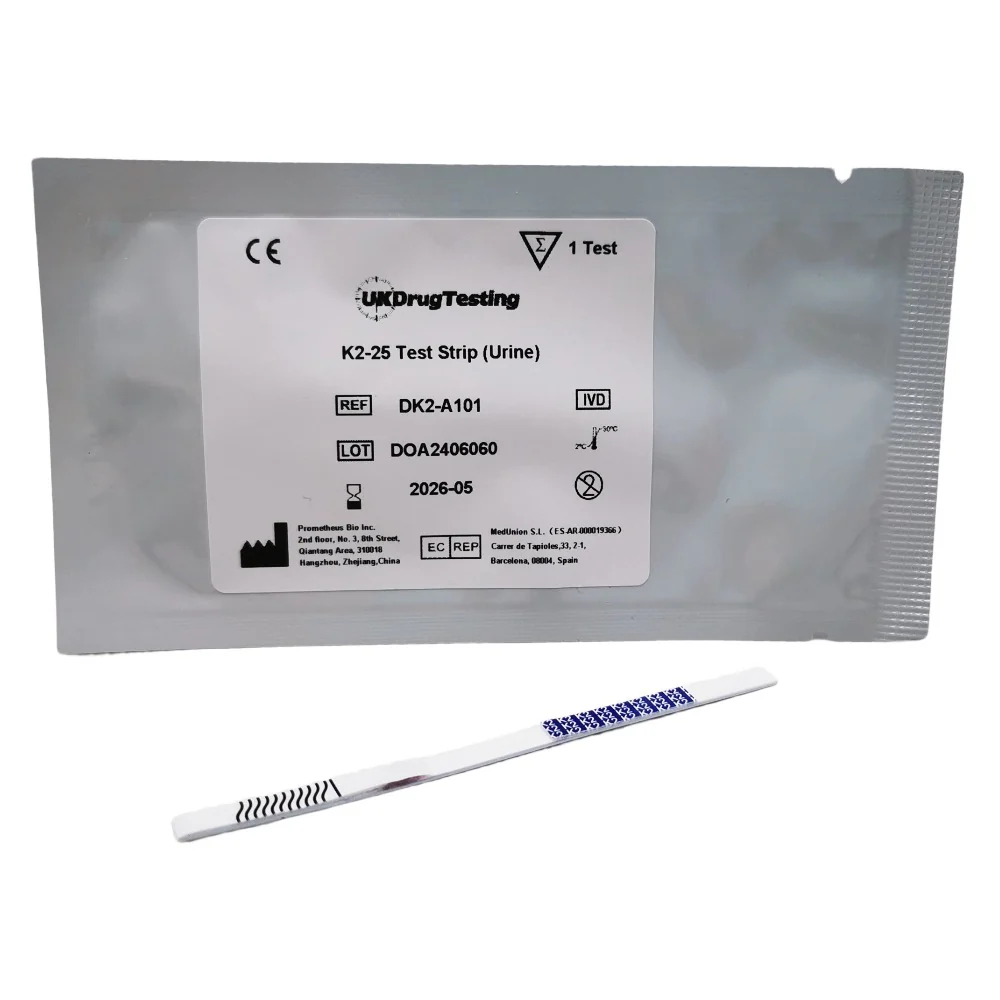
Yes. Specialized synthetic cannabinoid panels exist and are used in clinical, workplace, forensic, and treatment settings. These are separate products you have to request specifically.
Commercial and laboratory options include:
- Rapid dip-strip tests. Single-panel synthetic marijuana tests screen urine at a typical cutoff around 50 ng/mL for rapid results.
- Expanded laboratory panels. Some lab panels detect a wide range of compounds — one Any Lab Test Now panel, for example, detects 19 K2/Spice drug compounds and metabolites in urine.
- Reference-lab confirmation testing. Major labs like Labcorp offer a synthetic cannabinoids (K2, Spice) screen with reflexed confirmation on urine, used to detect the use of synthetic cannabinoid drugs. Note that these are lab-developed tests, not FDA-cleared, which is standard for this drug class.
The catch is coverage. Because there are hundreds of synthetic cannabinoid compounds and new ones appear constantly, no single panel catches everything. A test built to detect the JWH-generation compounds may completely miss a newer formula — which is one more reason the “I’ll just pass by using K2” mindset backfires.
What Type of Sample Is Used — Urine, Blood, or Saliva?
Urine is by far the most common sample for a K2 or Spice drug test. It offers the widest detection window because tests target metabolites, which linger longer than the parent drug.
Saliva (oral fluid) can confirm recent use. According to Redwood Toxicology Laboratory, the presence of the parent drug in saliva confirms ingestion, with an average detection window of up to 24–48 hours.Blood is used mainly in emergency or forensic settings, where clinicians need to know what’s active in the body right now rather than what was used days ago.
How Long Does K2/Spice Stay in Your System?
This is where synthetic cannabinoids get genuinely unpredictable, and where a lot of misinformation circulates. Detection windows depend on the specific compound, how often someone uses, their metabolism, and how sensitive the test is.
For occasional use, most sources put the urine detection window at roughly 72 hours to 7 days. Redwood Toxicology notes that after a single low dose, hydroxylated and carboxylated synthetic cannabinoid metabolites can be detected up to 72 hours in urine, with a much longer window in chronic use.
For chronic or heavy use, the window can be dramatically longer than people expect. Peer-reviewed research is clear on this. A study in the Journal of Analytical Toxicology found that after ingesting JWH-018, urine specimens remained positive for the JWH-018 metabolite over a period of 20 to 43 days (mean 27 days). A separate controlled-inhalation study reported that the predominant JWH-018 metabolite was still detected up to 4 weeks after use in some subjects. In extreme cases of prolonged heavy use, metabolites have been documented for months.
Here’s a general reference for occasional use — but treat these as rough estimates, not guarantees:
| Sample Type | Typical Detection Window (occasional use) |
|---|---|
| Saliva (oral fluid) | Up to 24–48 hours |
| Urine | 72 hours – 7 days (longer with heavy/chronic use; weeks for some compounds) |
| Blood | Short; mainly used for recent/active use |
The takeaway: nobody can promise you a reliable “clearance time.” The same batch of K2 can contain different chemicals in different amounts — even within a single packet — so two people, or the same person on two occasions, can test differently.
Why “Beating the Test” Is the Wrong Goal
It’s worth being blunt about the reasoning that brings many people to this topic. Synthetic cannabinoids became popular partly because they evade standard screens. But that supposed advantage comes with severe trade-offs:
- Synthetic cannabinoids are far more potent and unpredictable than cannabis. Many are full agonists at the brain’s cannabinoid receptors — unlike THC — which is why they’re linked to seizures, psychosis, kidney damage, and death.
- Testing is catching up. Employers and treatment programs in high-risk settings increasingly add synthetic cannabinoid panels precisely because people try to use K2 to skirt THC tests.
- The health risk dwarfs the testing risk. Choosing a drug because it’s “undetectable” trades a minor administrative risk for a major medical one.
If drug testing is a source of stress because of substance use, that stress is worth addressing directly — with a doctor, a counselor, or a confidential helpline — rather than by switching to a more dangerous drug.
Frequently Asked Questions
Does K2 show up on a standard drug test? No. A standard 5-panel or 10-panel drug test does not detect K2 or Spice. Synthetic cannabinoids are chemically different from THC and require a dedicated synthetic cannabinoid panel to detect.
Can K2 show up on a drug test at all? Yes, but only on a specialized synthetic cannabinoid test that is specifically ordered. Even then, because formulas change constantly, some newer compounds may go undetected.
How long does K2/Spice stay in your system? For occasional use, roughly 72 hours to 7 days in urine. With heavy or chronic use, certain compounds like JWH-018 have been detected for several weeks or longer in peer-reviewed studies.
Is a synthetic pot drug test the same as a marijuana test? No. A marijuana test looks for THC’s metabolite and will not flag synthetic cannabinoids. A synthetic pot drug test is a separate panel designed for K2/Spice compounds.
What sample is used for a Spice drug test? Urine is most common because it offers the widest detection window. Saliva can confirm very recent use, and blood is typically reserved for emergency or forensic situations.